From Concrete Floors to Clover Fields: The American Cheesemakers Trading Factories for Farmsteads

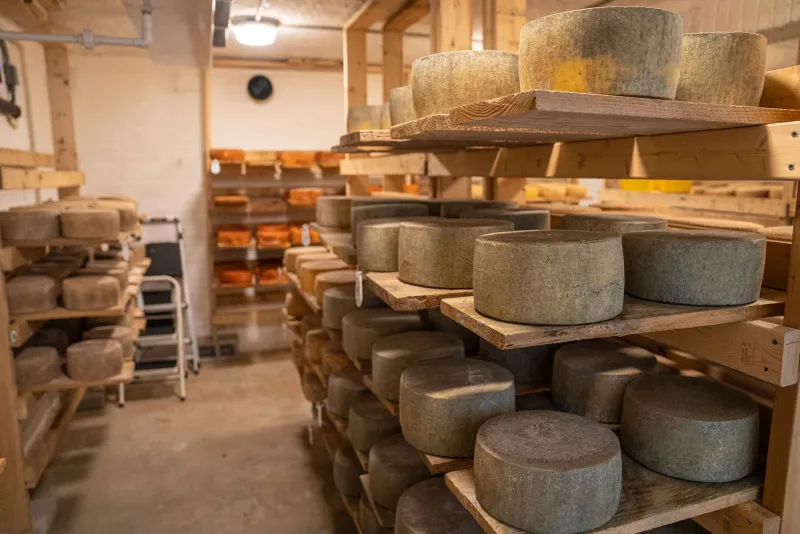
Photo: artisan cheesemaker aging cheese in rustic barn farmstead, via wallpaperaccess.com
There's a particular kind of madness that seems to afflict certain cheesemakers around year five or six of their careers. It usually starts small — a nagging suspicion that the milk arriving in refrigerated tankers from three counties over just doesn't taste like anything anymore. Then comes the late-night rabbit hole of reading about Alpine cheesemakers who live above their herds. Before long, they're Googling land prices in Vermont and asking their spouses if they've ever considered goats.
Welcome to the farmstead movement, the most delicious migration happening in American food culture right now.
The Problem with Playing It Safe
For decades, the blueprint for running a serious American cheese operation looked pretty much the same: lease or buy space in an industrial park, source milk from a cooperative, invest in stainless steel everything, and build a distribution network that could get your wheels into Whole Foods. It worked. It still works, for plenty of makers. But somewhere along the way, a growing contingent of cheesemakers started feeling like they were making really excellent product rather than genuinely extraordinary cheese — and they knew the difference.
The distinction isn't snobbery. It's terroir, that wonderfully untranslatable French concept that wine people have been using for centuries to explain why two bottles made from the same grape variety can taste like completely different conversations. Applied to cheese, terroir means that the specific grasses a cow grazes on, the mineral content of local water, the wild yeasts floating through a particular valley's air — all of it ends up, somehow, in your mouth. When your milk has traveled 200 miles in a tanker, a lot of that story gets lost in transit.
"I kept making technically correct cheese," says one Wisconsin-based maker who relocated her operation to a 40-acre farm in the Driftless Region four years ago. "Everything hit the benchmarks. But I couldn't tell you a single interesting thing about it. The milk was anonymous, and so was the cheese."
Barns: The Unlikely Stars of American Aging
Here's something the farmstead movement has accidentally discovered: old barns are phenomenal aging environments. Not because of romance, though there's plenty of that, but because of microbiology. The thick timber walls of a 19th-century dairy barn maintain remarkably stable temperatures. The earthen or stone floors contribute humidity. Generations of agricultural life have seeded the wood and air with complex microbial communities that commercial facilities spend enormous amounts of money trying to eliminate.
Several pioneering makers have converted their barn structures into what are now, by any measure, world-class aging caves. One producer in the Hudson Valley of New York has spent three years cultivating the specific mold environment in her repurposed hay loft, which she credits with giving her aged tomme its distinctly earthy, mushroomy rind. She has declined multiple offers from distributors who wanted her to scale up and move production to a larger, more efficient facility. Her answer, delivered with the serenity of someone who has made peace with her choices, is always the same: "The cheese would become someone else's cheese."
The Herd Changes Everything
The other piece of the farmstead puzzle — the one that genuinely cannot be replicated in an industrial setting — is the direct relationship between maker and animal. Farmstead cheese, by definition, is made with milk from animals the cheesemaker owns or manages directly. This isn't just a marketing point. It's a fundamentally different operational reality.
When you live with your herd, you know when a doe is off her feed. You know that your cows have been grazing the south pasture all week because the orchard grass is coming in strong, and you can taste the difference in the evening milk. You know that late-summer milk, rich and slightly grassy, will make a different cheese than the richer, more concentrated milk of early winter when the animals are eating hay. Rather than smoothing out these variations — which is exactly what commercial processing is designed to do — farmstead makers learn to work with them, coaxing them into seasonal cheeses that reflect a specific moment in a specific place.
A goat farmer and cheesemaker in Northern California's Sonoma County describes her production calendar as essentially a collaboration with her 60-animal herd. Her fresh chèvre in April, when the does are flush with spring milk, is almost effervescently bright and citrusy. By October, as milk production winds down, the same basic recipe yields something richer, more concentrated, and almost honeyed. Same animals. Same maker. Completely different cheese. "That's not inconsistency," she says firmly. "That's the whole point."
The Trade-Offs Are Real (And Worth Discussing)
It would be dishonest to paint the farmstead life as pure pastoral bliss. The makers who've made this leap are almost universally candid about the challenges. Land is expensive. Managing a herd is a full-time job layered on top of another full-time job. Rural locations complicate distribution and require customers to either seek you out or pay premium shipping costs. Regulatory compliance for on-farm production can be navigating a labyrinth blindfolded.
And then there are the animals themselves, which are, to put it diplomatically, not always cooperative business partners. Goats in particular seem to view fencing as a philosophical suggestion rather than a physical boundary.
But ask any of these makers whether they'd go back, and the answer is almost always a laugh followed by an emphatic no. Because what they've gained — genuine connection to their product, the ability to make cheese that couldn't exist anywhere else on earth, and the satisfaction of knowing exactly where every wheel came from — turns out to be worth quite a lot of inconvenience.
What This Means for Your Cheese Board
For those of us who eat cheese rather than make it, the farmstead movement has one very practical implication: the most interesting American cheeses right now are increasingly coming from small, geographically specific operations that you might have to hunt a little to find. They may not be at your nearest grocery store. They might be available only seasonally. The wheels might be irregular in shape because they were pressed by human hands rather than machines.
These are features, not bugs. At CheeseZoo, we've made it our particular obsession to track down exactly these kinds of producers — the ones who traded the loading dock for the barn door and never looked back. Because the cheese that results from that trade? It tastes like a decision made with conviction. And conviction, it turns out, is a genuinely delicious ingredient.