Quit Your Day Job (And Your Dairy Contract): The Artisan Cheesemakers Going Gloriously Rogue
There's a particular kind of madness that strikes a cheesemaker around year seven of selling commodity milk to a processing cooperative. It usually starts with a question — what if I just... didn't? — and ends with a farmstead creamery, a maxed-out line of credit, and the most satisfying cheese you've ever tasted in your life.
Welcome to the Great Cheese Escape. Pull up a milking stool.
The Golden Handcuffs of Industrial Dairy
For decades, the path for small American dairy farmers was basically pre-written. You raise your herd, you sign with a co-op or a large processor, and you deliver milk at whatever price the market decides that week. It's not glamorous, but it's predictable — and in agriculture, predictable is basically a luxury good.
The problem? Predictable has been getting a lot less profitable. Commodity milk prices have swung violently over the past fifteen years, leaving small producers particularly exposed. Meanwhile, the artisan cheese market — the funky, the aged, the locally storied — has grown into a multi-billion-dollar segment that makes grocery store cheddar look like a participation trophy.
"I was getting $14 per hundredweight for milk I'd spent 20 years perfecting the genetics to produce," says Marcus Holt, who ran a Jersey dairy operation in central Vermont before launching his creamery, Dovehill Cheese, in 2019. "Meanwhile, wheels of raw-milk tomme from farms half my size were selling for $28 a pound at Whole Foods. The math stopped being complicated pretty fast."
Holt's story is increasingly common. The fantasy of cutting out the middleman — and the co-op, and the broker, and the commodity price board — has gone from pipe dream to viable business model for a growing number of producers. But the escape route is steep, and not everyone makes it.
The Financial Reality Check Nobody Warns You About
Here's what the Instagram version of going independent leaves out: the first two years are financially terrifying in a way that makes commodity dairy look like a trust fund.
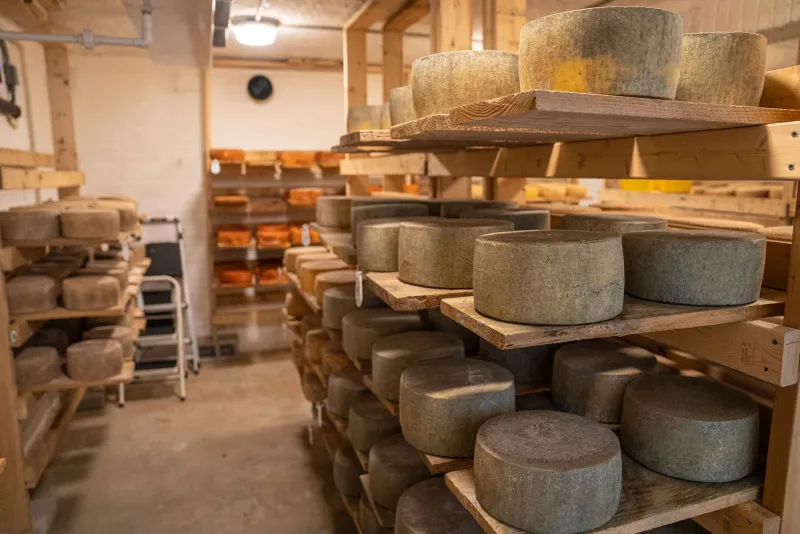
Building or converting a licensed creamery can run anywhere from $150,000 to well over $500,000 depending on scale, state regulations, and whether your local inspector has a sense of humor. You need aging space, pasteurization equipment (if you're not going raw-milk), packaging, labeling compliance, and — perhaps most expensively — time. Aged cheeses don't pay rent while they're sitting in a cave developing their personality.
Sylvia Tran left a co-op arrangement in Wisconsin's Driftless Region in 2021 to produce a line of washed-rind cheeses under the name Fen & Fog. She's candid about the gap between inspiration and cash flow.
"I had a business plan, a great product, and absolutely no idea how long it would take to build a wholesale account," she says. "The cheese was ready. The market took another 14 months to catch up with me."
Tran survived the gap with a combination of farmers market sales, a small CSA-style cheese subscription, and what she diplomatically calls "creative personal finance." She's now supplying four regional restaurant groups and two specialty retailers — but she'll tell you the first winter was genuinely grim.
The Creative Liberation Is Very, Very Real
And yet. And yet.
Ask any producer who's made the leap what surprised them most, and almost none of them lead with the hardship. They lead with the cheese.
When you're selling milk into a commodity pool, the quality of what you produce matters only up to a point — it has to meet standards, full stop. When you're making cheese under your own label, every variable becomes a creative decision. The breed of your herd. The season. The cultures you use. The duration and conditions of aging. Whether you wash the rind in local cider or leave it alone entirely.
"I made the same cheese for six months and then I just... changed it," says Holt, describing his evolution from a straightforward alpine-style wheel to a more complex, cellar-aged format with a natural rind. "Nobody had to approve that. Nobody sent me a memo. I tasted something I wanted to chase and I chased it."
This creative autonomy is exactly what the artisan market rewards — and what industrial supply chains structurally cannot accommodate. A co-op doesn't care that your milk tastes different in October when the cows shift to hay. An artisan cheesemaker builds an entire cheese around that shift.
The Ones Still Plotting Their Exit
Not everyone has made the jump yet, and the reasons are as varied as the cheeses themselves.
Dave and Carmela Ostrowski run a 60-head Guernsey operation in upstate New York and have been "about 18 months away" from launching their own label for approximately three years. The hesitation isn't passion — they've been making cheese for family and friends for a decade, and their aged gouda-style wheel has reduced more than one houseguest to emotional silence at the dinner table.
It's the timing. A teenager heading to college. A barn that needs a new roof. The knowledge that their current co-op arrangement, however soul-flattening, covers the mortgage.
"We know what we want to make," Carmela says. "We just need the window to open a little wider before we jump through it."
This is the other face of the Great Cheese Escape — the waiting room. Populated by people who are good enough, ready enough, and simply waiting for the moment when the risk calculus tips far enough in favor of the leap.
What the Market Wants (And How Long It Took to Want It)
The encouraging news for anyone still in the waiting room: the American consumer has never been more interested in knowing exactly who made their cheese and why. The same cultural forces that made people care about single-origin coffee and small-batch bourbon have arrived, fully and enthusiastically, in the cheese aisle.
Specialty food sales in the US have climbed consistently for over a decade, and artisan and farmstead cheeses have outpaced the broader category. Retailers from Wegmans to independent bottle shops to online platforms (hi, that's us) are actively hunting for producers with a story, a sense of place, and a cheese that tastes like someone genuinely cared.
"The demand side has never been the problem," says Tran. "The problem is surviving long enough to meet it."
For the escapees who've made it, that survival — and the cheese on the other side of it — turns out to be worth every terrifying month. For the ones still at the co-op, still doing the math, still dreaming about what they'd make if nobody was telling them what to make: the gate is open. The question is just when you're ready to run.
CheeseZoo celebrates the makers, the risk-takers, and the slightly feral dreamers who believe the world needs more interesting cheese. We're rooting for every last one of you.