Curd Nerd Nation: Meet the Renegade Cheesemakers Rewriting America's Dairy Playbook
There's a moment in every great zoo visit when you spot the animal that absolutely shouldn't exist — the one so magnificent and unexpected that you have to grip the railing and stare. American artisan cheese is having that moment right now. While the industrial dairy complex churns out its pre-sliced, vacuum-sealed, shelf-stable product by the millions of pounds, a loose confederation of gloriously stubborn cheesemakers is doing something genuinely radical: making cheese that tastes like somewhere.
This is the Great American Cheese Rebellion, and it smells absolutely fantastic.
The Problem with Processed (You Already Know, But Let's Say It Anyway)
For most of the 20th century, American cheese culture got flattened — literally and figuratively. Industrial consolidation pushed small dairies out of business, homogenized milk lost its regional character, and the word "cheese" became associated with a product that, let's be honest, has more in common with a chemistry experiment than a farmhouse tradition. By the 1980s, the United States was producing more cheese than almost any country on Earth and somehow managing to make it deeply, profoundly boring.
But here's the thing about boring: it creates a market for the opposite.
Vermont: Where the Cows Have Better Views Than You Do
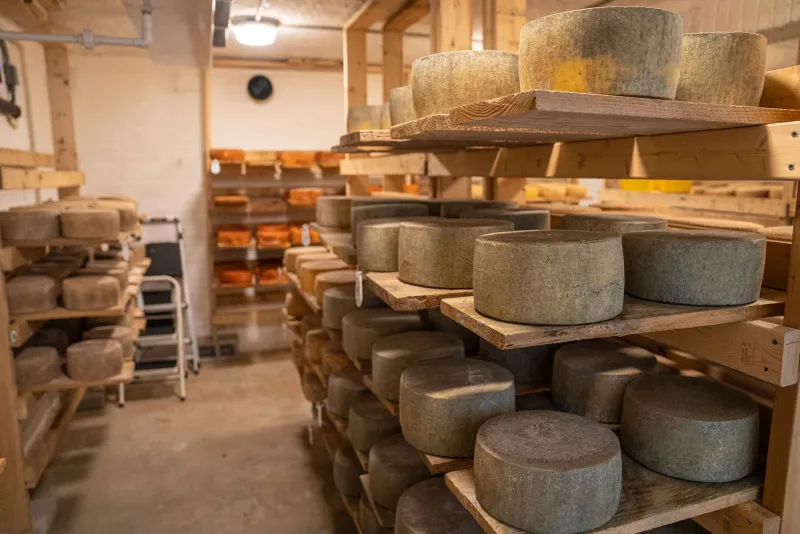
If American artisan cheese has a spiritual homeland, it might just be Vermont, where the rolling hills look like a screensaver and the cheesemakers have the quiet intensity of people who have made a very specific life choice and are completely at peace with it.
Creameries like Jasper Hill Farm in Greensboro have become international benchmarks. Their Winnimere — a bark-wrapped, spoonable, funky-gorgeous wheel washed in local beer — has appeared on cheese boards from Brooklyn to Bali. It's the kind of cheese that makes French affineurs raise an eyebrow in grudging respect, which, if you know anything about French affineurs, is basically a standing ovation.
What Vermont cheesemakers figured out early is that the state's cool climate, lush pastures, and small-scale farming infrastructure weren't disadvantages to be overcome — they were ingredients. The milk from a Jersey cow grazing on Vermont clover in October doesn't taste like the milk from a Holstein in a feedlot in the Central Valley. That difference, amplified through careful cheesemaking, becomes something you can actually taste.
"We're not trying to make a Vermont version of a French cheese," one Vermont cheesemaker told us, gesturing at a cave full of aging wheels with the casual pride of a person showing off their vacation home. "We're trying to make a Vermont cheese. Full stop."
Wisconsin: The OG Dairy State Gets Its Groove Back
Wisconsin has been making cheese since before it was cool, uncool, and cool again. The state has more licensed cheesemakers than any other in the country and a Master Cheesemaker certification program that is, frankly, more rigorous than most graduate degrees. For decades, though, the state's identity was tied to its commodity output — cheddar by the ton, mozzarella by the tanker truck.
The artisan wave hit Wisconsin differently than it hit Vermont. Rather than starting from scratch, a generation of Wisconsin cheesemakers began excavating their own heritage — reviving styles that immigrant Swiss, German, and Scandinavian settlers had brought over a century ago and then largely abandoned in the rush to industrialize. Producers like Uplands Cheese Company, whose Pleasant Ridge Reserve has won more American Cheese Society awards than any other cheese in history, proved that Wisconsin's dairy tradition could produce something genuinely world-class without apology or qualification.
What's particularly delightful about the Wisconsin artisan scene is its democratic scrappiness. These aren't boutique operations for wealthy hobbyists. Many are working farms that added a creamery to survive economically, run by people who will cheerfully discuss milk protein ratios at 6 a.m. while wearing coveralls. The cheese is exceptional because the people making it are exceptionally serious about their craft — not because they're performing seriousness for a lifestyle brand.
California: Where Cheesemaking Gets a Little... Experimental
If Vermont is cheese's soul and Wisconsin is its spine, California is definitely its id. The state's artisan cheese scene reflects everything you'd expect from a place that also gave the world avocado toast and natural wine: it's adventurous, occasionally eccentric, and more often than not, genuinely brilliant.
Point Reyes Farmstead Cheese Company, perched on a windswept bluff above the Pacific, makes an Original Blue that has converted more blue cheese skeptics than any other American cheese we can name. Cowgirl Creamery, founded in the 1990s in a converted hay barn in Point Reyes Station, built an entire artisan cheese movement around organic milk and funky, washed-rind wheels that smell like a forest floor in the best possible way.
California cheesemakers also benefit from the state's extraordinary agricultural diversity. Goat milk from Sonoma, sheep milk from the Sierra Nevada foothills, cow milk from the coastal fog belt — the raw material variety alone makes California a cheesemaker's playground. Add in a food culture that's genuinely excited about provenance and flavor, and you've got a self-reinforcing ecosystem where bold experiments get rewarded.
Why This Matters Beyond the Cheese Board
The American artisan cheese movement isn't just about producing tastier snacks for people who own too many charcuterie boards (though it is absolutely doing that). It's about rebuilding a food system that had been almost entirely severed from its regional roots.
Small creameries support small dairies. Small dairies support sustainable land management. Sustainable land management supports the kind of diverse, healthy pastures that produce the distinctive milk that makes the cheese taste like somewhere in the first place. It's a virtuous cycle — one that, unlike the industrial alternative, produces something you'd actually want to eat.
The American Cheese Society now has over 1,000 members. The United States regularly medals at international competitions where, not long ago, our entries would have been politely ignored. Specialty cheese counters at grocery stores that didn't exist 20 years ago are now common in cities across the country.
The rebellion is working. And the cheese has never been wilder.
Ready to taste the revolution? Browse our collection of American artisan cheeses at CheeseZoo.com, where every wheel has a story and the cows are (metaphorically) free-range.