Chaos Theory, but Make It Delicious: The Wild Fermentation Revolution in American Cheese
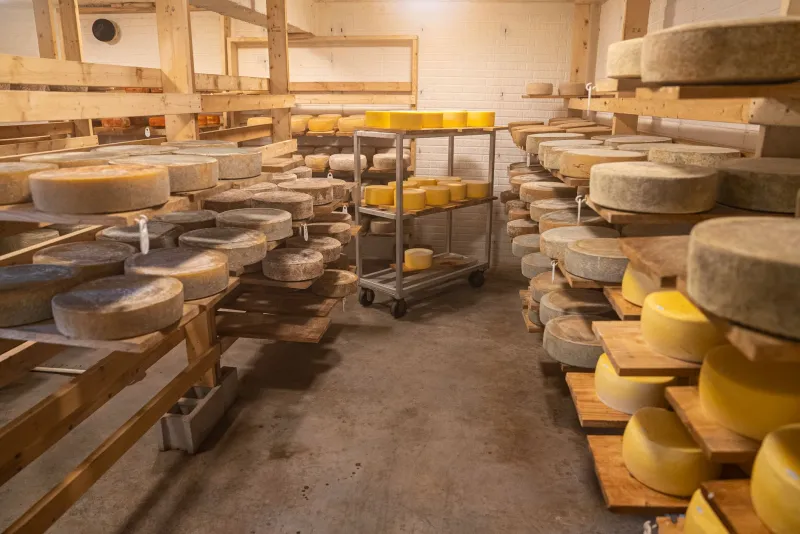
Somewhere in a converted root cellar in Vermont, a wheel of cheese is doing something its maker cannot fully predict. The bacteria responsible for its flavor weren't ordered from a supplier, cultured in a lab, or selected for consistency. They blew in through an open barn door, hitched a ride on the cheesemaker's sleeve, or have lived in the wooden shelves of this particular aging room since before anyone currently working here was born.
This is wild fermentation — and it is, depending on your perspective, either the most exciting thing happening in American artisan cheese right now or an extremely expensive way to make something that might not work.
Possibly both.
The Standard Model (And Why Some People Find It Boring)
To understand why wild fermentation is a big deal, you need to understand what most cheesemaking looks like from a microbial standpoint. The vast majority of commercial and artisan producers use what are called starter cultures — freeze-dried or liquid bacterial preparations purchased from companies that specialize in producing consistent, reliable microbial blends. You buy your culture, you add it to your milk at the right temperature, and the bacteria do their job in the way bacteria from that culture always do their job.
This is not a bad system. It produces consistent, safe, high-quality cheese. It's also the reason your favorite farmstead cheddar tastes the same in January as it does in July, which is genuinely useful if you're running a business.
But consistency, as any jazz musician or experimental baker will tell you, is not the same thing as personality. And there's a growing cohort of American cheesemakers who have decided that personality is exactly what they're after — even if chasing it means inviting a certain amount of productive chaos into their process.
What 'Wild' Actually Means
Wild fermentation in cheese is the practice of relying on the naturally occurring microorganisms present in raw milk, the production environment, and the aging space to drive fermentation rather than introducing a commercial starter culture. It's the cheese equivalent of making sourdough bread with a wild-caught starter instead of commercial yeast — a practice that produces something deeply connected to a specific place and time, and almost impossible to perfectly replicate.
The microbial cast of characters in a wild-fermented cheese can include native lactobacillus strains, wild yeasts, naturally occurring molds, and a supporting ensemble of bacteria whose names require a biochemistry degree to pronounce confidently. What they produce together — the acids, the enzymes, the aromatic compounds — is the flavor of the cheese. Change the microbiome and you change the cheese. Change the season, the pasture, the humidity in the cave, the wood of the aging boards, and you change the microbiome.
This is also called terroir, a concept most Americans know from wine. Applied to cheese, it means that a wheel made from milk produced in a specific place, by specific animals, at a specific time of year, can taste like that place in a way that no standardized culture can replicate.
"There's a flavor I get in late September milk that I've never been able to produce in any other month," says Lena Marchetti, who makes a line of raw-milk washed-rind cheeses in the Hudson Valley under the name Stonebreak Dairy. "When I was using commercial cultures, I was basically overwriting that flavor. Now I'm trying to amplify it."
The Terrifying Part
Here's where we get honest about the downside, because wild fermentation is not a story with only charming, photogenic chapters.
When you invite unpredictability into a cheesemaking operation, unpredictability shows up. Sometimes it brings extraordinary results — a wheel with a flavor complexity that stops tasters mid-sentence. Sometimes it brings a batch that has gone somewhere unintended and cannot be sold. Sometimes it brings both, in the same week, from the same milk.
"I've lost batches," says Marchetti, with the matter-of-fact tone of someone who has made peace with a difficult truth. "Not often. But it happens. You learn to read the signals earlier, you adjust, and sometimes you're still wrong."
For producers working at small scale — where every wheel represents real money and real labor — a failed batch isn't an abstraction. It's a meaningful financial loss. This is why wild fermentation remains a practice of the genuinely committed rather than the casually curious. You have to want what it produces badly enough to accept what it sometimes costs.
Food safety adds another layer of complexity. Raw milk and wild cultures require rigorous environmental monitoring and deep familiarity with what normal looks like in your specific production environment, so you can recognize when something has gone wrong early enough to intervene. The cheesemakers doing this well are not cavalier — they're obsessive, in the best possible way.
The Science of Productive Chaos
It would be a mistake to frame wild fermentation as purely romantic and anti-scientific. The producers doing it most successfully are deeply engaged with the microbiology of what they're producing — they're just interested in understanding and working with a more complex microbial ecosystem rather than replacing it with a simpler one.
Some are partnering with food science researchers at universities to map the microbial communities in their milk and aging environments. Others are building personal databases of their own seasonal variation, essentially learning to read the microbial story of their production space across years of observation.
"I know what my cave smells like when it's happy," says Thomas Arkwright, who ages a line of natural-rind tommes in a converted stone structure on his sheep farm in the Ozarks. "I know what it smells like when something's off. That knowledge took three years to build and I couldn't have gotten it from a textbook."
Arkwright's approach is typical of the more sophisticated wild-fermentation producers: deeply empirical, highly localized, and founded on the conviction that the microbial community in a specific place is a resource to be cultivated rather than replaced.
What It Tastes Like
All of which is interesting, but let's talk about what ends up on the cheese board.
Wild-fermented cheeses tend toward greater complexity and variability than their culture-standardized counterparts. They often carry flavors that are harder to categorize — not just "nutty" or "sharp" but something more like a conversation between multiple flavor threads that shift as the cheese warms and opens up. They can be more aggressive, more aromatic, more surprising. They can also be more divisive; not every palate responds enthusiastically to the kind of barnyard intensity that a truly wild-fermented washed rind can produce.
But for the consumers who seek them out — and their numbers are growing — wild-fermented cheeses offer something that standardized production genuinely cannot: the taste of a specific place, made by specific hands, at a specific moment in time. A wheel that is, in some meaningful sense, unrepeatable.
In a food culture that increasingly values the authentic over the optimized, that's not a niche selling point. It's the whole point.
Why This Matters Beyond the Cheese Cave
The wild fermentation movement in American cheese is part of a broader cultural reckoning with what we've traded away in the pursuit of consistency and scale. It's a cousin to the natural wine movement, the heritage grain revival, and the return of sourdough as a serious craft — all of which share the conviction that the microbial and biological complexity we've spent decades engineering out of food was doing something valuable that we're only now beginning to appreciate.
For CheeseZoo, this is exactly the kind of story we exist to tell. The cheese that tastes like somewhere. The maker who's willing to let the bacteria vote. The wheel that comes out of the cave as a surprise, even to the person who made it.
That's not chaos. That's character.
Curious about wild-fermented cheeses? Our shop features a rotating selection of producers working with native cultures and raw milk. Because some of the best things in life are slightly unpredictable.